
How to Buy Ex-Display Appliances Without Getting Caught Out
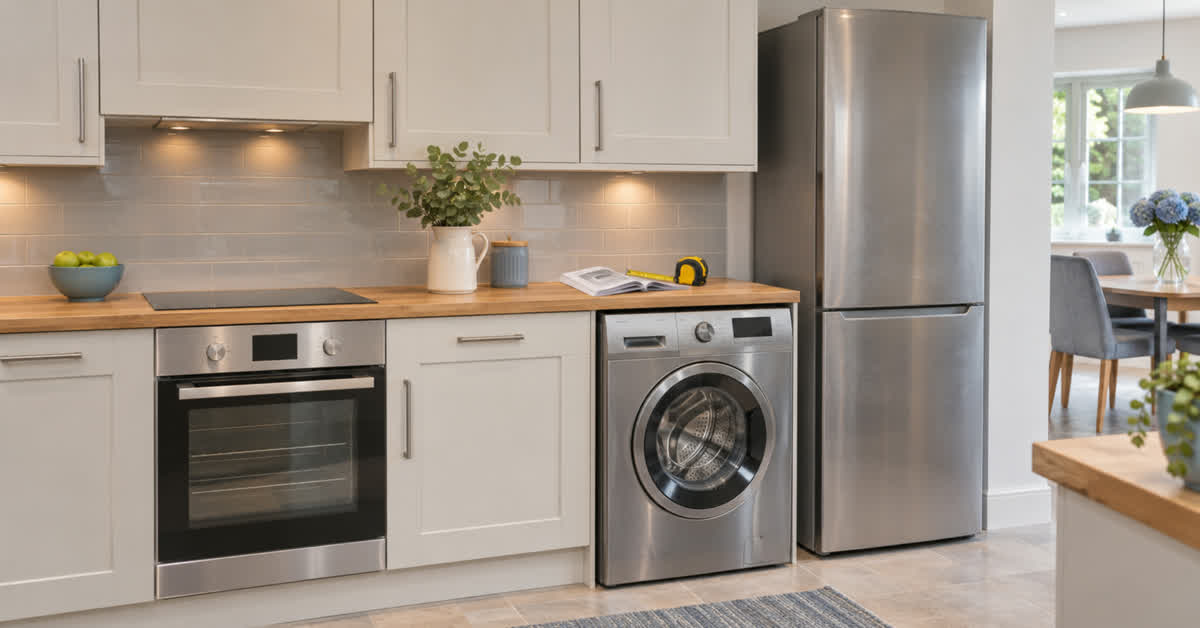
An ex-display appliance can leave a very welcome bit of money in the kitchen budget. That is the appeal. A washing machine with a few showroom fingerprints, or an oven used for demonstrations, can be a far better buy than a sealed box at full price.
But a bargain appliance has to earn its keep. It needs to fit the gap, come with the useful bits, be safe to install and have cover you can actually use. I'd rather lose a tempting discount than end up with a fridge in the hallway and no way of getting it through the door. Here's the sensible check before you pay, with the faff kept to a minimum.
If you want the wider picture first, our complete ex-display guide explains why condition and price vary so much. Appliances need a few extra checks, mind you.
First, work out what you are actually buying
Ex-display normally means the appliance has been put on show so people can look at it. Doors may have been opened, buttons pressed and shelves rearranged. Ex-demo means it has been used for demonstrations, so an oven, coffee machine or washing machine may have run properly rather than sitting there looking pretty. Graded is a seller's description of condition, often covering dents, scratches or damaged packaging. There is no universal grading scale, so ask what that seller's grade means in plain English.
Clearance can mean end-of-line, discontinued or surplus stock, and it may still be boxed. Refurbished suggests a returned item has been inspected and perhaps repaired. That is different from a display model. Our guide to ex-display, ex-demo and clearance has the terminology laid out, but the rule I use is simple: read the condition notes, not the cheerful adjective.
Ask what has been switched on, how long it has been used, what has been repaired and which accessories are included. A missing fixing kit, drain hose or oven shelf can turn a lovely-looking price into a bit of a faff. Cosmetic marks are one thing. Missing essentials are another.
The model number is your best friend
Get the complete model number before comparing prices. A brand name and a photograph are not enough. The exact code takes you to the right manual, dimensions, energy information, installation instructions and spare parts. Ask for a clear photograph of the rating plate too. It could be inside the door, on the side of an oven, behind a washing machine door or inside a fridge compartment.
Write down the serial number while you're there. Search the model on the manufacturer's own website, then check the official GOV.UK product safety alerts, reports and recalls page. A display appliance doesn't get a safety exemption because it has spent its life under showroom lights. Search before you buy, and search again after delivery if the serial number is available.
You can also use Register My Appliance to register old as well as new appliances and receive information about safety repairs or recalls. Keep the receipt, seller details, model and serial number together. Take photographs of marks you accepted before paying. It is dull admin, but much less dull than arguing about which dent was already there.
Energy labels need a proper look
The rescaled A to G label doesn't apply to every appliance in the same way. GOV.UK lists dishwashers, washing machines and washer-dryers, plus refrigerating appliances, among the product groups covered by energy-labelling rules. Other products have different arrangements. Tumble dryers and ovens aren't something I'd lump into the same sentence without checking the actual model and its label.
Look at the scale, the capacity, the energy figure and the noise information. On a washing machine, for example, the label may show consumption per 100 cycles and water use per cycle. A large appliance can use more in real life than a smaller one even if the class looks respectable. The label is a useful running-cost clue, not a promise that your household will use exactly the stated amount.
Where the label carries a QR code, scan it and compare the details with the manufacturer's information or the official product database. Check that the label belongs to the exact model in front of you. An almost identical model number is still the wrong model number. If you're looking at ex-display appliances and white goods, save the model code with the listing before it disappears.
Warranty cover is where the small print earns its keep
I'd never assume that a manufacturer's warranty transfers, starts again or applies to an ex-display appliance. The answer can depend on the brand, the date and place of purchase, registration, proof of purchase, installation and the seller's status. Ask for the answer in writing before you hand over money.
NEFF is a useful example, not a universal rule. Its UK warranty page says every NEFF home appliance has two years' standard cover. Its warranty terms require proof of purchase and set out exclusions including improper installation, poor maintenance, transport damage in some circumstances and unauthorised repairs. That doesn't tell you what another manufacturer will do. Check the terms for the exact model and ask if display stock is treated differently.
My questions would be these: does cover run from my purchase date or an earlier sale; does the brand require registration within a set period; are cosmetic marks excluded; are labour, parts and call-out included; and does installation have to be approved? If nobody can give you a straight answer, price the appliance as though a repair will be yours to pay for. Sometimes the saving still stacks up. Sometimes it is lipstick on a very expensive pig.
Give it the once-over by appliance type
Washing machines and washer-dryers: open the door and inspect the seal for splits, mould and grit. Check the detergent drawer, drum, hoses and connections. Turn the drum by hand and ask for a fill, drain and spin demonstration if that is possible. Confirm that the inlet hose, drain hose, transit bolts and stacking kit are included. No hoses is not an automatic no, but budget for the correct replacements.
Fridges, freezers and wine coolers: check every shelf, drawer, seal and hinge. Look for cracked plastic, frost damage, dents around the door and corrosion near the base. Make sure the door opens fully where you plan to put it. Ask how long it has been running and how it will be transported. Check the manual for ventilation clearances. If you're browsing wine coolers and drinks fridges, measure the cabinet opening as carefully as you would for a full-height fridge.
Ovens and hobs: check the door hinges, seal, glass, racks, trays, runners, knobs and touch controls. Confirm the shelves and grill pan are there. On an induction hob, look closely for chips and hairline cracks. Ask for the electrical load and installation instructions. For gas, check the model and installation requirements before making any assumption about who can fit it. Our ex-display ovens and hobs category is a useful place to compare models, but the plate and manual matter more than the photograph.
Dishwashers: slide out both baskets, check the rollers and spray arms, open the detergent dispenser and inspect the door seal. Look for missing cutlery trays, brackets, screws and the door-fitting template. Integrated dishwashers need the correct furniture door, hinge arrangement and a stable, level opening. A bargain that can't be secured properly isn't a bargain I'd bring home.
Tumble dryers and smaller appliances: check the drum, filter housing, water container, condenser area and plug. With a heat-pump dryer, ask for the manual and confirm the filter and drainage arrangements. With coffee machines or other ex-demo items, check cleaning cycles, removable parts, water tanks, accessories and descaling instructions. Demonstration use can leave more residue than a quick wipe suggests.
Integrated or freestanding? Measure the whole job
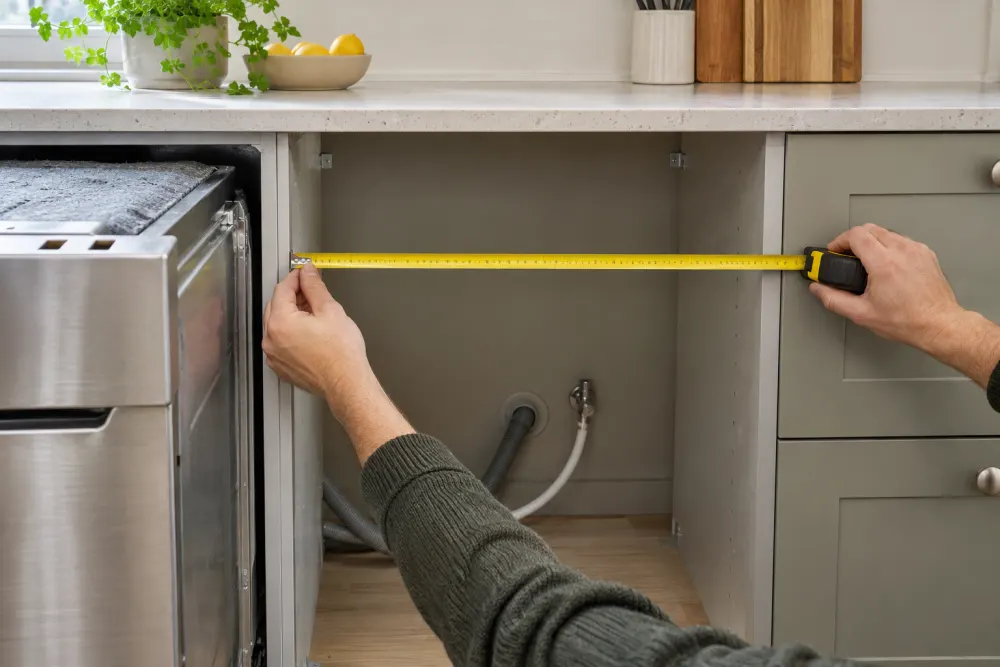
Freestanding is simpler, but it still needs room for doors, hoses, ventilation and removal. An integrated appliance has to work with the cabinet height, width, depth, plinth, furniture door and hinge arrangement. Measure the opening and the route into the room. Also measure the space needed to pull the appliance out for repair.
Measure doorways, stairs, turns and lifts. Compare those figures with both packaged and unpackaged dimensions. Do not rely on “standard size”. Kitchens have a habit of being standard right up until the appliance is 4 mm too wide.
If you're planning a bigger kitchen job, our ex-display kitchens buyer's guide covers units, worktops and included appliances. The same discipline applies to one washing machine. Your tape measure is cheaper than a failed delivery.
Installation is part of what you are paying for
Gas work is no place for a DIY saving. In a domestic property, work on gas fittings must be carried out by a Gas Safe registered engineer who is qualified for that work. Check the engineer on the Gas Safe Register and ask to see the back of the card for the relevant appliance category. That covers gas ovens, cookers and hobs.
With electric ovens, Electrical Safety First says many come with a standard plug while others have to be hardwired into a dedicated circuit, and even a plug-in one can need its own circuit so it doesn't overload the kitchen wiring. It wants a qualified electrician doing the fitting, especially if the cooker is over 3kW or a new circuit is needed for one over 2kW. Follow the manufacturer's instructions and use the Electrical Safety First oven guidance if you need to check the basics. A delivery driver is not there to improvise a hardwired connection. For help finding an electrician, GOV.UK points householders to the Electrical Competent Person Register.
Ask the seller what installation includes. It might mean putting the appliance in the room, not connecting it. Check the cost of unpacking, door reversal, fitting an integrated furniture door, gas connection, electrical connection and testing. Old-appliance disconnection may be separate too. Get the whole figure before you decide how much you are saving.
Delivery and the old appliance
Confirm the delivery method, access requirements and who is responsible for damage in transit. Ex-display appliances may be collection only, kerbside delivery or delivered without original packaging. Ask how the appliance will be protected, whether it will come upstairs and if the driver needs a clear route.
Arrange old-appliance removal before delivery if you need it. Some services take away a like-for-like appliance, but conditions vary. They may refuse one that is still full of water, disconnected incorrectly or impossible to reach. Fridges and freezers need particular care, and washing machines should be drained before moving. If removal is not included, price a licensed waste service or local recycling option. The cheapest appliance is less cheap if it sits in the hallway for three weeks.
My keep-more-of-your-money checklist
- Get the exact model and serial numbers, plus a photograph of the rating plate.
- Check the actual energy label and figures for that model, not a similar one.
- Search GOV.UK product recalls and register the appliance after purchase.
- Inspect seals, hinges, controls, trays, hoses, racks and accessories.
- Measure the appliance, the cabinet, the route in and the space for future repairs.
- Read the manufacturer's warranty and get the seller's condition notes in writing.
- Price installation, delivery, old-appliance removal and missing parts.
There's no prize for forcing a dubious bargain into your kitchen. The one I'd choose is the appliance that fits, passes the sensible checks and still leaves money in the pot for the boring bits. Have a look through the appliances and white goods, keep the tape measure handy and walk away if the answers don't add up.
This is general buying guidance, not a substitute for the manufacturer's instructions or advice from a qualified installer.