
Buying a Second-Hand Sofa Without the Guesswork
A second-hand sofa can be one of the best ways to get a proper piece of furniture without paying full-price money. It can also be a large, upholstered mystery with a life you know nothing about. I’m all for a bargain, but I want to know what’s holding it up, what’s inside the cushions and how it’s getting through the front door.
This is different from buying a tidy ex-display sofa from a business. A second-hand sofa might be a private sale, a charity-shop find, an auction lot or a regular trader’s stock. The seller, the condition and the law can all change with that route.
Look at the frame before the fabric
Start underneath. Get someone to sit on each end and in the middle while you listen for creaks and watch the frame. A little movement in a loose cushion is normal. A frame that twists, rocks or knocks is another matter.
Check the legs and how they attach. They should be present, straight and secure, with no fresh-looking cracks around the fixings. Look along the front rail and the arms for sagging or a bow. On a corner sofa, inspect every join. Sections that don’t lock properly can creep apart when the sofa is used.
Run your hands over the back and arms. You’re feeling for hard lumps, broken boards, loose webbing and repairs hidden under the cover. Don’t be embarrassed about looking. You’re buying a big, heavy object that will dominate the room for years.
Cushions tell you quite a lot
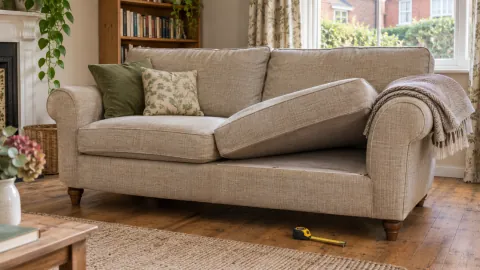
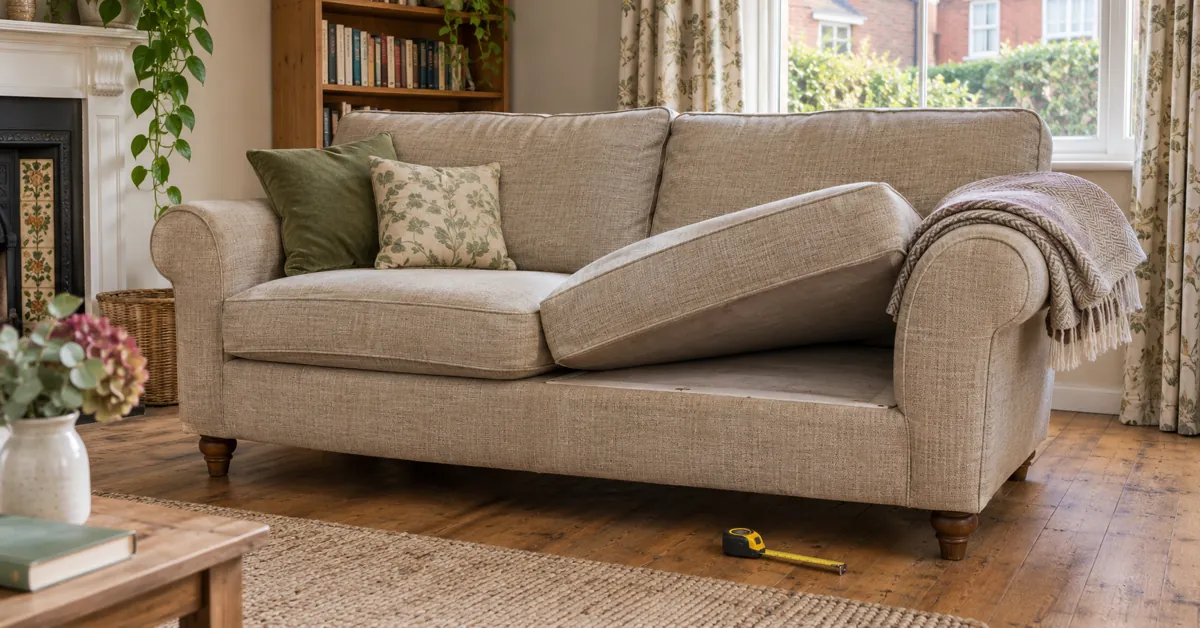
Remove every cushion if you can. Check the covers, zips, seams and piping. Sit in the usual places and then swap sides. If one seat has collapsed while the others are plump, ask why. Foam and fillings can be replaced, but the cost and effort belong in your decision.
Look under the cushions and behind the back cushions for crumbs, staining, damp, pet hair or signs of insects. You’re not trying to perform a laboratory inspection in somebody’s lounge. You are looking for clues. A heavy perfume or a recently draped throw can sometimes be there to hide a smell.
For a sofa bed, open and close the mechanism yourself. Check that it locks, the frame moves without grinding and the mattress is present and clean. Measure it open as well as closed. A sofa bed that can’t open without moving three other pieces of furniture is a very occasional bed indeed.
When you inspect a listing, sit down for several minutes rather than giving it a quick bounce. Check the back support, seat height and arm position. A sofa can be structurally sound and still be wrong for the way you use your room. Comfort is personal, so no photograph can settle it for you.
Fire-safety labels changed, so read the detail
The Furniture and Furnishings (Fire) (Safety) Regulations 1988 cover upholstered furniture, including sofas, sofa beds, cushions and mattresses. Bromley Council’s trading standards guidance says used furniture must meet the same standards as new furniture on sale in the shops. That matters for second-hand sales, not only high-street shops.
Since 30 October 2025, the 2025 amendment has removed the old requirement for a display label and changed the treatment of certain baby and young children’s products. It also removed some second-hand provisions and extended the time for bringing proceedings. Don’t turn that into “labels no longer matter”. GOV.UK’s guidance on the changes says second-hand supply of furniture still requires a permanent label.
I’d ask for a clear photograph of any permanent label, usually attached under a cushion or to the frame. If the seller has removed it, can’t show it or says the sofa is too old to know, treat that as a serious question. Bromley’s guidance says furniture that cannot be verified as safe through the permanent label needs to go to a waste recycling centre, not be casually passed on.
The law is about safety, not whether the colour suits your sitting room. A faded cover can still be safe. A beautiful sofa with unknown foam and no useful history is not automatically a safe buy.
Private sale, business sale or charity shop?
With a private seller, goods still need to be described accurately, but you generally don’t get the same quality and fitness protections as you do from a trader. Ask direct questions and keep the answers. “Some wear” is not a useful description if the seat has a torn base, a broken mechanism or a deep stain underneath.
A business seller has duties under consumer law. If the sofa is faulty or misdescribed, the trader’s obligations are different from a private seller’s. On a marketplace, check the seller’s status rather than assuming a friendly first name means private. Someone who regularly buys and sells furniture may be acting as a business.
Charity shops and auctions need their own common sense. A charity shop may have checked the basics, but don’t assume it has tested every mechanism or verified every label. At an auction, read the catalogue condition notes and inspection rules. Collection deadlines and no-return terms can make a cheap lot expensive very quickly.
Ask these questions before you travel
- How old is it, and do you know the make or model?
- Has it been in a home with smokers or pets?
- Are there stains, tears, repairs, smells or marks not shown in the photos?
- Are all cushions, feet, fixings and sofa-bed parts included?
- Can you send a photograph of the permanent fire-safety label?
- Does it split into sections, and what are the largest pieces?
- Who is arranging delivery, and what happens if it doesn’t fit?
If the answers become vague as soon as you ask about the underside, I’d let that one go. There will be another second-hand sofa. There may not be another painless way to get a suspicious one back out of your hallway.
Getting it home is part of the price
Measure the sofa, the sections, the stair turns, the lift, the front door and the narrowest point between the pavement and its final room. Measure diagonally as well as straight across. A corner sofa can fit on paper and fail at the first turn.
Ask how it will be protected in transit. Don’t drag it by the arms or stack heavy pieces on cushions. If collection is your job, take enough people and the right vehicle. A second-hand sofa with delivery can still be good value, but delivery is part of the buying decision, not an afterthought.
Once it arrives, inspect it before signing anything that says it arrived in good condition. Photograph marks, labels and damage straight away. If a business seller delivered it, write promptly if the description and the actual sofa don’t match.
If you’re buying a sofa with delivery, agree whether the old sofa is removed, whether the new one is brought into the room and what happens if the access measurements fail. Put it in writing. It sounds fussy until the sofa is sitting on the pavement and everyone is looking at you.
What I’d happily buy, and what I wouldn’t
I’d happily buy a well-made sofa with a sound frame, honest wear, cleanable covers, a visible safety label and measurements that work. I’d be more cautious about a sofa bed with a tired mechanism, a corner sofa that cannot be separated, or anything with damp, strong odours or unexplained upholstery.
I’d also be wary of a “second-hand Chesterfield” where the seller can’t say what it is made from or show the underside. The style tells you almost nothing about the frame, foam or compliance history. A familiar shape is not a certificate.
Our site carries independent listings, so always read the actual seller’s description and delivery terms. Browse our ex-display furniture if you’d prefer display pieces, and read the ex-display sofa guide for a different buying route. For upholstered items, the official fire-safety guidance is worth keeping open while you check the label.
A second-hand sofa doesn’t need to be perfect. It needs to be honestly described, structurally sound, safe to supply and capable of getting into your house. That’s a much better bargain than a pretty photograph and a very expensive headache.