
B&Q Ex-Display Kitchens: What to Check Before Buying
Searching for B&Q ex-display kitchens usually means one thing: you’ve seen a kitchen you like and you’d rather keep some money in the bank. Fair enough. A display kitchen can be a smart buy, but the words “B&Q ex-display” get used rather loosely online, and that’s where the muddle starts.
I checked B&Q’s own customer pages in November 2026. B&Q has an official kitchen range, kitchen planning, installation and a general clearance area. I didn’t find a customer-facing B&Q ex-display kitchen shop or a published list of showroom kitchens being sold as ex-display. So I wouldn’t treat every old B&Q door or kitchen advertised elsewhere as an official B&Q outlet bargain.
There are three different things hiding under the same search phrase: an official B&Q clearance product, a kitchen that has genuinely been removed from a B&Q display, and an independent seller offering B&Q-compatible or previously owned bits. They can all be worth a look. They need different checks.
What B&Q actually offers
B&Q’s own clearance page covers kitchen clearance among its wider clearance departments. That’s an official route for reduced goods, but clearance is a selling route, not a description of the item’s history. The page doesn’t say that all kitchen clearance is ex-display, and it would be a mistake to read it that way.
B&Q also offers kitchen planning appointments and an installation service using approved installers. Its installation page says the process starts with a planning appointment, followed by a survey and a detailed installation quote. That’s the neat, supported route for a new B&Q kitchen. A dismantled display bought through an independent seller is a different job entirely, with more measuring, more missing-part detective work and nobody automatically coordinating the rebuild.
B&Q’s terms also describe guarantees for some kitchen products. The published Cooke & Lewis and IT kitchen guarantee covers named cabinets, doors, drawer fronts and related parts for ten years from purchase, subject to its conditions. It says the guarantee is non-transferable if the kitchen has been removed from the premises where it was first installed and reinstalled elsewhere. That matters enormously for a display kitchen. Ask for the original proof of purchase and the exact guarantee terms, then assume a second owner may not get the same cover unless B&Q confirms it in writing.
Clearance, discontinued doors and ex-display aren’t twins
Old stock can be perfectly good stock. A discontinued door can be perfectly usable. Neither fact proves that a kitchen has been on a showroom wall.
Clearance may mean a range is changing, a line is being reduced, packaging is damaged or a particular product is being moved on. “Ex-display” ought to mean that the item has been used as a display, but you still need the seller to explain what was displayed, for how long, and what has happened since it was taken apart.
I’d be especially wary of listings that use “B&Q ex-display” in the title but don’t show the backs of the doors, the cabinet interiors, the hinge positions or the cut-outs. A familiar retailer name can make a listing feel safer than it is. The hinges and end panels are the boring bits that decide if your bargain becomes a kitchen or an expensive pile of green doors.
Doors and old stock can be the clever bit
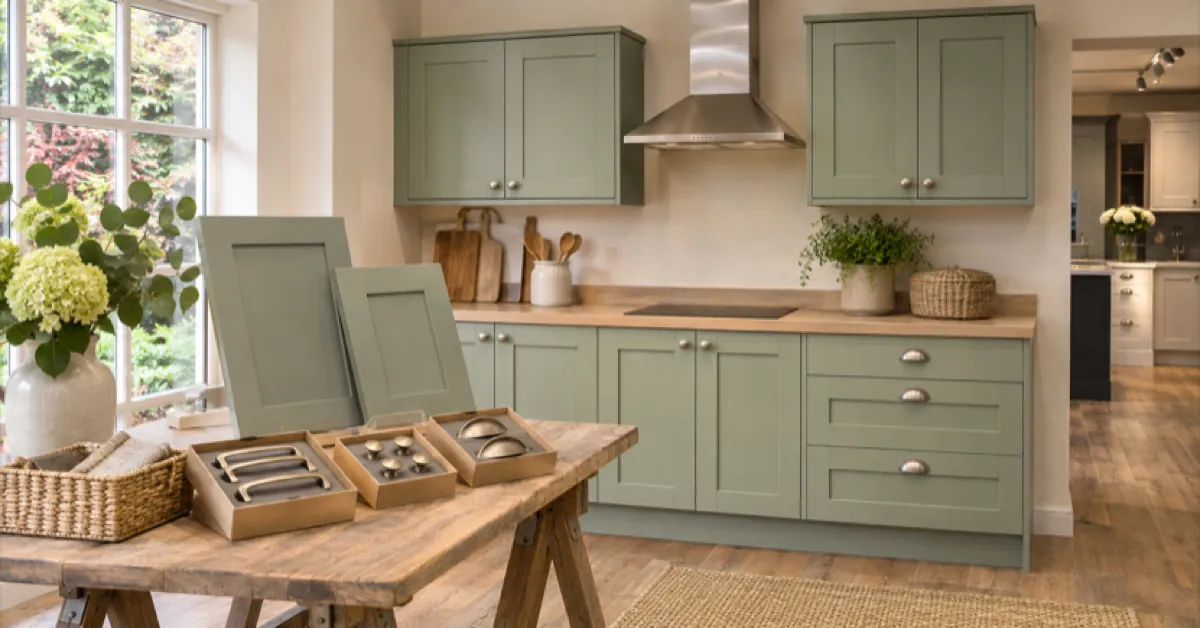
If your existing cabinets are sound, replacement doors or old stock can give the room a lift without buying a whole kitchen. Measure every door, drawer front and end panel. Don’t rely on the range name alone. You need the actual width, height, thickness, hinge drilling and fixing arrangement.
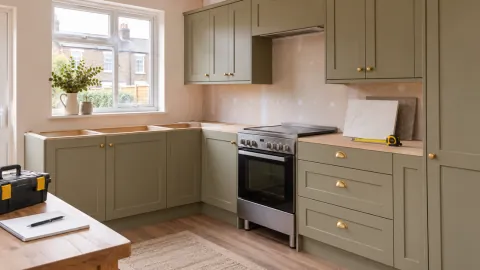
For a full display, count the cabinets rather than admiring the photograph. A display may have one attractive run, but your room may need a sink base, fillers, end panels, plinth, cornice, appliance housings and a corner solution that the seller hasn’t included. A bargain price on the visible doors can turn into a very ordinary price once the missing bones are added.
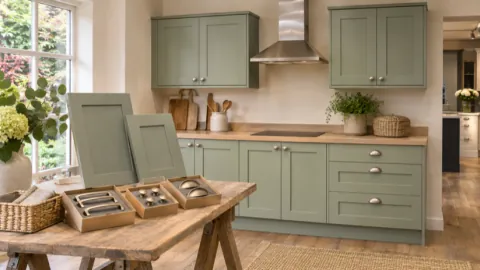
Colour is another trap. Kitchen doors photographed under showroom lighting can look different in a north-facing room. If the seller can provide a loose door or a clear daylight photograph, take it. I’d rather spend a little time comparing a sample than discover that the “soft grey” is a cold green once it’s beside your floor.
What to ask about a B&Q display kitchen
Before paying a deposit, ask for a written inventory. Not a sketch with a few measurements, and not “everything in the photos”. I mean a list you can tick off.
- What is the exact range or door name, and is it still supported by B&Q?
- How many base, wall and tall cabinets are included?
- Are the doors and drawer fronts included, with handles and hinges?
- Are end panels, fillers, plinths, cornice, legs and joining rails included?
- What worktop is included, and has it been cut for a sink, hob or wall?
- Are appliances included, and do they have model numbers and manuals?
- Has anything been drilled, glued, trimmed, painted or repaired?
- Which marks are on the display, and which parts are new or unused?
- Who dismantles it, and who is responsible if a door or rail is damaged during removal?
- Can you inspect the pieces before collection, including the cabinet backs and fixings?
Get photographs of the individual pieces, rather than only the polished display. I’d want the hinges open, drawers pulled out and worktop edges visible. A chip at the back may not matter. A cut edge where you need a clean end panel absolutely might.
The money-saving bit has a few sharp edges
A display kitchen can save money because some of the design work has already happened and the visible units may be priced to leave the showroom. It can also add cost through dismantling, transport, storage, replacement fixings, alterations and the parts that were never included in the first place.
Measure your room before you fall for the photograph. Note doors, windows, pipes, sockets, boiler flues and awkward corners. Check ceiling height for tall housings. Check the route from the seller to your kitchen, including stairs, narrow doors and turns. Your tape measure is cheaper than a failed delivery.
Worktops deserve their own bit of suspicion. A display worktop may already have a sink hole, hob cut-out, joint or finished edge in the wrong place. Sometimes that’s usable. Sometimes you’re paying to buy a large piece of material that needs replacing. If the worktop has been cut, price the kitchen with and without it.
Appliances can be the same story. Ask for the exact model, age, condition and test arrangements. Don’t pay a premium because a stainless door looks smart. A used appliance needs its own decision about warranty, installation and removal, and it may not suit the cabinet dimensions you’ve inherited.
Official B&Q purchase or independent listing?
If you’re buying directly from B&Q, its returns page says most purchases can be returned in original condition within 90 days, with proof of purchase. It also says cut-to-size, made-to-measure and products mixed to your requirements are excluded from that change-of-mind policy. Kitchens are full of items that may be tailored, cut or installed, so read the exact order terms before assuming you can send the lot back.
B&Q’s site also hosts verified sellers. Its returns information says products sold and shipped by a verified seller should be returned through that seller, and some larger items cannot be returned in a store. Check who the contract is with at checkout. The B&Q logo on a web page doesn’t automatically mean B&Q supplied the item.
An independent ex-display seller is another proposition again. Ask for the seller’s full name, business address, written condition description, collection or delivery terms and what happens if a listed cabinet is missing. If you’re buying privately, be even more careful with the inventory and payment. A well-written receipt won’t make a missing corner cabinet appear, but it will at least give you something definite to check against.
My sensible B&Q kitchen checklist
- Decide if you need doors, cabinets, a complete run or simply inspiration.
- Measure your room and make a list of the pieces you actually need.
- Get a full inventory, dimensions and close photographs before travelling.
- Price missing panels, fillers, handles, worktops, appliances and delivery.
- Confirm how the display is dismantled and what happens if something breaks.
- Check the seller, payment method, receipt and written condition description.
- Only then compare the total with a new B&Q design and installation quote.
I like a kitchen bargain that leaves room in the budget for the unglamorous things, because kitchens are full of unglamorous things. Just keep the retailer name in its proper place. B&Q’s official clearance route is one thing. A genuine showroom display is another. An independent listing is another again. Know which one you’re buying, and the old doors might be the clever part rather than lipstick on a very expensive pile of mismatched cabinets.